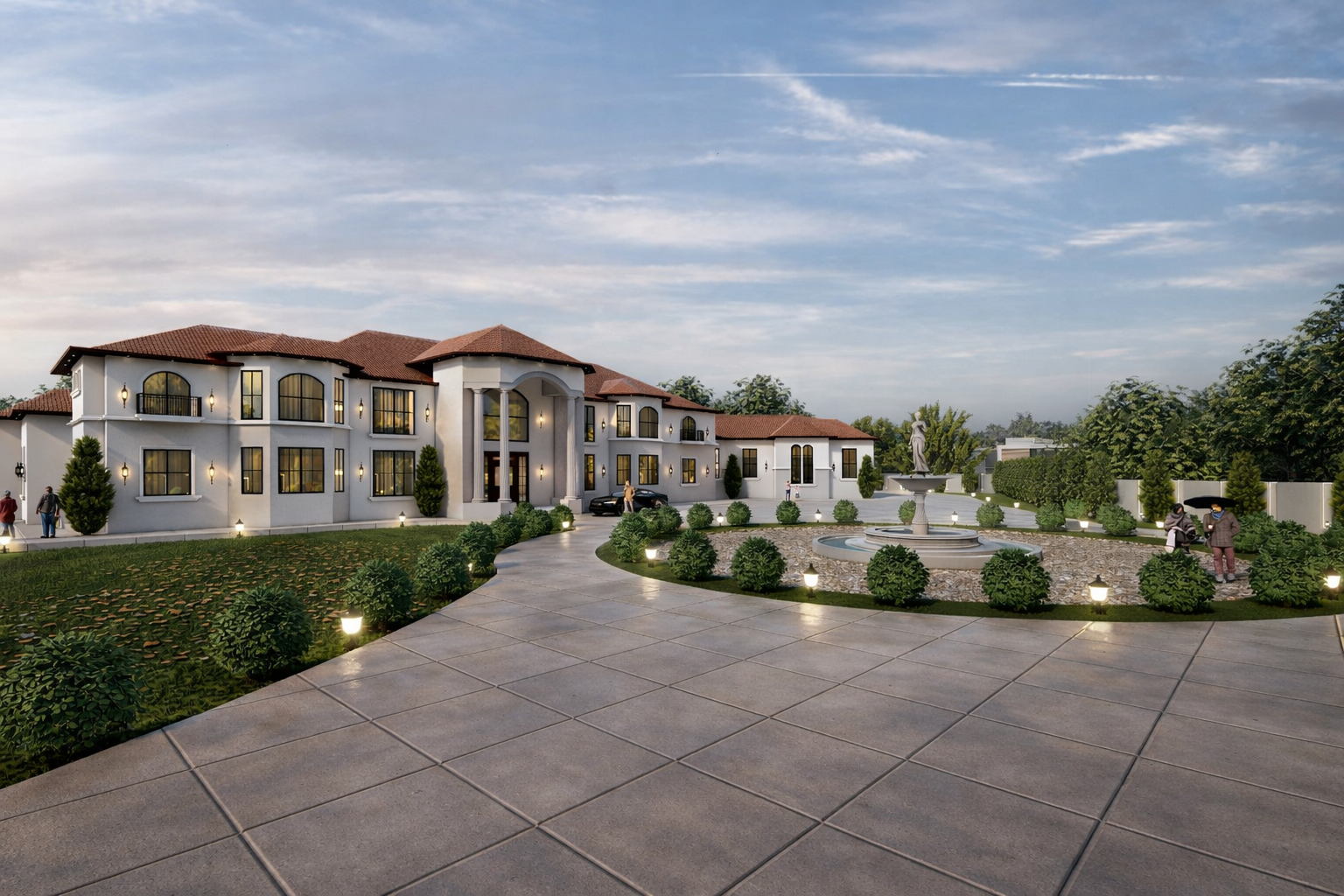
Almost every successful mid-sized architecture firm we work with has, at some point, tried to bring rendering in-house and quietly retreated. The rendering bottleneck is one of the most predictable scaling problems in the industry — and one of the easiest to solve once you understand the trade-offs.
The rendering bottleneck
Architecture firms grow on the strength of their design output. The moment rendering starts eating design hours, the firm is paying senior designers ₹2,000+ per hour to fight with V-Ray for a deliverable a specialist could produce in half the time at a third of the cost. Multiply that across a portfolio of fifteen active projects and you have a structural drag on profitability.
The three options: in-house, freelancer, dedicated studio
Every architecture firm sizing rendering capacity faces the same three choices.
In-house renderer
Pros: Full control. Tight feedback loop. Renderer learns the firm's house style. Confidentiality stays inside the building.
Cons: Expensive (a senior renderer + software licenses + workstation comes to ₹150,000–₹250,000 per month all-in in India, $8,000–$15,000 in the US). Capacity is fixed — busy weeks back up, slow weeks waste salary. One person leaves and the pipeline collapses. Full in-house vs outsource breakdown.
Freelancer
Pros: Pay per project. No fixed cost. Some excellent freelancers exist.
Cons: Reliability collapses at scale. Cannot handle three projects in parallel. Disappears mid-revision. No backup if they fall ill. Quality varies enormously between projects.
Dedicated rendering studio
Pros: Predictable turnaround. Capacity scales with your pipeline. Multiple artists trained on your house style. NDAs in place. Software licenses, hardware and render farm capacity are the studio's problem, not yours.
Cons: Per-project cost looks higher than freelancer rates on the surface (it usually is not, once you factor in failure rate). Less control than in-house.
What to look for in a rendering partner
- Portfolio that matches your style ceiling. A studio that has only ever rendered budget housing will not deliver luxury hospitality at the standard you need. Ask to see work in your typology and price tier.
- Clear, documented turnaround times. "Around two weeks" is not a turnaround. "8 business days for a single exterior, 12 for a typical interior set, 15 for a 60-second walkthrough" is.
- Defined revision policy. How many free rounds? What is the hourly rate beyond? Get this in writing before you start.
- Communication discipline. Same-day responses on WhatsApp or email. A named project lead, not a rotating cast.
- NDA willingness. Any studio that hesitates to sign your NDA is the wrong studio.
- Software compatibility. They should accept your file format (Revit, SketchUp, ArchiCAD, AutoCAD) without forcing conversions on you.
- Volume pricing. If you are a 50+ render/year firm, you should be on a retainer with discounted rates and a dedicated artist.
Red flags
- No portfolio, or only generic stock-style renders.
- Quoted rates that are wildly cheaper than the market — usually means juniors with no oversight.
- Vague timelines and no clear process documentation.
- Refuses to sign your NDA.
- No clear point of contact for your project.
More on this in our five red flags when hiring a rendering studio.
How the handoff works in practice
A typical first project with us looks like this. You send your CAD or SketchUp file plus a couple of reference images you like the look of and any material specifications. We confirm scope and turnaround within a few hours over WhatsApp. We sign your NDA. We deliver a draft preview by day 3, take your feedback, deliver a near-final by day 6, take revisions, deliver final at day 8. Two free revision rounds are included; anything beyond that is billed at our published hourly rate.
The case for outsourcing to India
Indian rendering studios offer 60–80% cost savings against US, UK and UAE studios at equivalent quality. The talent pool is deep — India has been training architectural visualization artists for over two decades and now supplies talent to studios in London, Dubai and New York directly. Time-zone coverage is excellent: morning UK, full UAE overlap, late-evening EST. English is the working language. WhatsApp, email and Zoom are all standard.
The takeaway
If your firm is doing more than ten renders a year, outsourcing to a dedicated studio almost always wins on total cost, capacity and quality. The trick is studio selection — and the test is whether you can hand them a brief on Monday morning and have a draft preview on Wednesday without chasing.
If you run an architecture firm and are tired of the rendering bottleneck, see our dedicated architecture-firm partnership or talk to us on WhatsApp at +91 96467 24313.