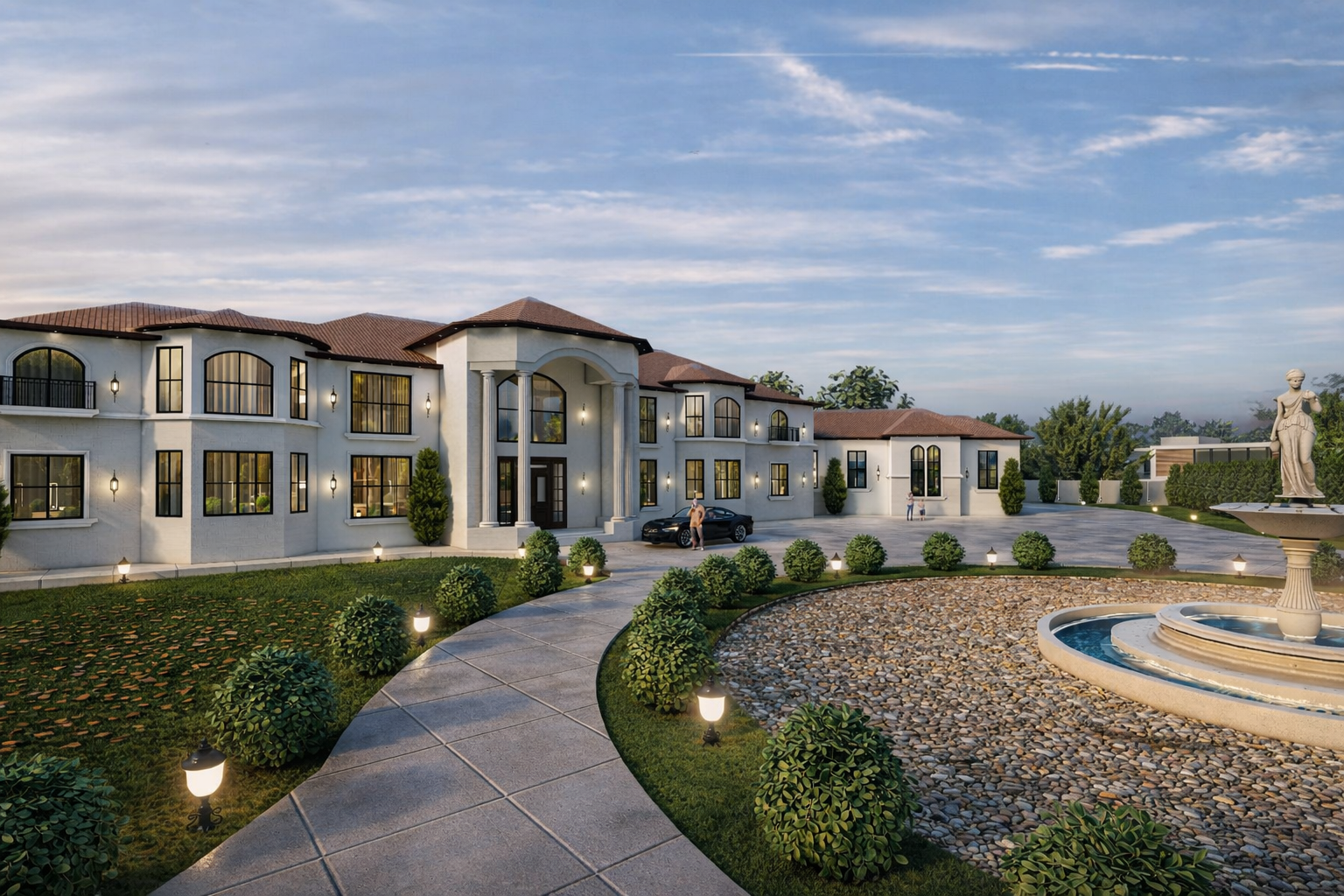
We use V-Ray, Corona, Lumion and Unreal Engine every day. Each one is the best tool for some part of our pipeline and the wrong tool for others. The endless online debates about which engine is "best" miss that the answer is always "for what?". Here is what each one is actually good at, where each one falls down, and how we pick between them on real projects.
V-Ray
V-Ray is the industry-standard photoreal renderer. It has been the benchmark for over twenty years and remains the engine most senior archviz artists were trained on.
Strengths: Unmatched photorealism for stills. Deep material library. Mature production pipeline. Industry-standard — every senior renderer can use it. Excellent integration with 3ds Max, SketchUp, Rhino and Revit. Reliable renders that hold up at print resolution.
Weaknesses: Slow for animations — render times scale linearly with frame count and quickly become uneconomic. Steep learning curve. License cost.
When we use it: Hero exterior shots, hero interior shots, anything that has to hold up at A2 print or larger, anything for high-end real-estate marketing.
Corona Renderer
Corona is the easier-to-use cousin of V-Ray, optimised for interiors. In many studios it has overtaken V-Ray as the default for interior work.
Strengths: Easier to learn than V-Ray. Outstanding interior rendering — particularly material accuracy on fabrics, timber and stone. Interactive rendering that updates as you tweak materials. Lower license cost than V-Ray.
Weaknesses: 3ds Max only (no SketchUp or Rhino integration). Slightly less flexible than V-Ray for unusual exterior lighting setups. Smaller community than V-Ray.
When we use it: Almost all interior renders. Residential, hospitality and commercial interiors. Anything where material realism is the headline.
Lumion
Lumion is the speed champion. It trades a little photorealism for an order-of-magnitude speed advantage, and that trade is the right call on a huge number of projects.
Strengths: Real-time preview — see your scene as you build it. Massive built-in library of plants, people, vehicles and props. Walkthrough animations in days instead of weeks. Lower learning curve than V-Ray or Corona. Excellent for fast client previews and iteration.
Weaknesses: Less photorealistic than V-Ray for hero stills. Material control is less granular. Look can become recognisable ("that's a Lumion render") if not handled carefully.
When we use it: Walkthroughs that need to come back fast. Master-plan flythroughs. Concept-stage previews. Aerial fly-throughs of large townships.
Unreal Engine
Unreal Engine is a full real-time game engine, increasingly used for archviz at the high end. It is the future of real-time and VR rendering.
Strengths: True real-time path tracing on modern GPUs. Outstanding for VR experiences. Lumen and Nanite produce film-quality lighting and geometry. Cinematic walkthroughs in real-time, no per-frame render farm.
Weaknesses: Steep learning curve — it is a game engine, not an archviz tool. Requires high-end hardware. Material and lighting setup is more involved than Corona or V-Ray. Smaller pool of trained archviz artists.
When we use it: VR experiences for ultra-luxury clients. Real-time walkthroughs where the client wants to navigate freely. Large commercial and master-plan projects with budget for high-end interactive deliverables.
Summary table
| V-Ray | Corona | Lumion | Unreal | |
|---|---|---|---|---|
| Photoreal stills | ★★★★★ | ★★★★★ | ★★★★ | ★★★★ |
| Speed | ★★ | ★★★ | ★★★★★ | ★★★★★ |
| Walkthroughs | ★★ | ★★★ | ★★★★★ | ★★★★★ |
| VR / interactive | — | — | ★★★ | ★★★★★ |
| Learning curve | Steep | Medium | Easy | Steep |
| Cost | $$$ | $$ | $$ | Free (royalty) |
How we pick on a real project
For a single hero exterior at high resolution: V-Ray. For a set of interior renders: Corona. For a 90-second walkthrough on a tight deadline: Lumion. For a VR experience: Unreal. For most real-world client work, we end up using two of the four — V-Ray or Corona for stills, Lumion or Unreal for the walkthrough.
What about D5, Twinmotion, Enscape, Octane?
D5 and Twinmotion are real-time competitors to Lumion and are gaining ground fast — particularly D5 for interiors. Enscape is the popular SketchUp/Revit plugin for fast in-flow previews. Octane is GPU-based with strengths for product viz. We use D5 occasionally for fast interior previews; the others are not currently in our daily pipeline.
Pick the studio first, the engine follows
The honest answer to "what engine should I ask for?" is: do not. Pick a studio whose work you like and trust them to choose the right engine for your brief. A great studio with the wrong engine will still beat an average studio with the right one.
Need a render and not sure which engine fits? Tell us about your project — we will pick the engine for you. WhatsApp +91 96467 24313 or contact form.